Showing posts with label Peace Corps Training. Show all posts

Monday, January 26, 2015

Chocolate Week, de nuevo!

One of the things I most looked forward to during my training as a Peace Corps Volunteer was our cacao technical training- or, as I like to call it, Chocolate Week.  Since generally even the most educated and experienced agriculture volunteers have little experience working with tropical Panamanian crops like cacao, we receive an additional week-long, in-depth training a few months after arriving to our sites.  

Why the wait?  Well, sometimes you just have to experience life and work in your site to know what types of questions you need to be asking.  


Whereas the majority of Pre-Service Training is led by office staff, technical weeks during In-Service training are facilitated almost entirely by second year volunteers who have excelled in the main sub-project areas (Cacao, Coffee, and Rice and Fish Tanks).  One of my closest friends, Zoe, is the National Cacao Coordinator and together we chose to host cacao week (heretofore referred to as "chocolate week") in my site due to the relative ease of transport and local technical support.

So what did we plan for our volunteer visitors during chocolate week?  Nothing but five days of wonderful, chocolate bliss. Cacao volunteers have many projects working on both sides of the production chain ranging from farm planning to agroforestry techniques and finally (my favorite) chocolate processing and product marketing.  Since the volunteers focused on the earlier parts of the chain during Pre-Service Training, most of our week was focused on the latter steps.

Day 1 
The first day we reviewed the most tedious agroforestry technique-grafting, and also taught the volunteers about pruning since the trees weren't quite ready to be cut back until now.  

Grafting is a tricky technique that entails inserting a tiny part of a healthy tree into an older, lower producing tree.  If and when the new graft sticks, you'll eventually cut away the old tree and leave the new one to grow and take advantage of the older, more developed root systems.  This process can completely revitalize older farms, but is sadly hard to master. 

Cacao flowers-The very beginning of chocolate!

Day 2
To quote a Spanglish version of the 4-H motto, hay que (you've got to) "learn by doing." We took that to heart and threw the volunteers straight into the fire the second day by assigning them to plan and facilitate a Farmer's Field School for the producers in my site.  

Lucky for them, Zoe had pre-planned most of an amazing work-day that taught farmers how to make GPS maps of their farms and take inventories of the hundreds (or thousands) of trees that they have.  We had a very successful day and several other producers have already asked me to help with their farms next!  I'm almost jealous of the baseline data my follow-up volunteer will be inheriting...

Following a long day on the farm, we all came back to my house for my favorite part of the week- the "Chocolate Bar!"  We melted 100% cacao and dished bowls out to each volunteer who was then able to mix sweeteners (sugars, honey, and syrups), nuts, berries, and various other fillings and toppings to form their own chocolate bars (or lumpy balls, in our case). 


Day 3
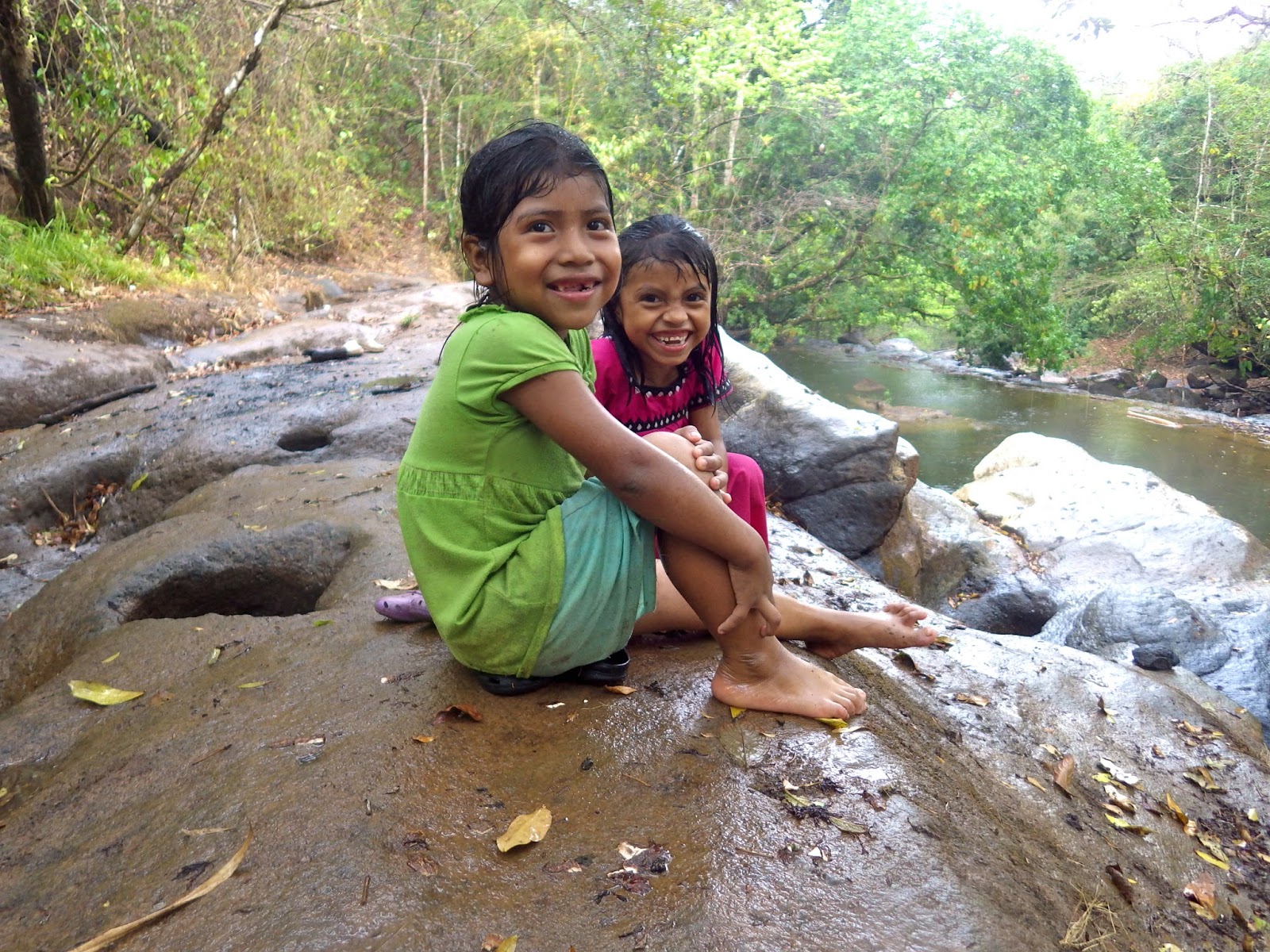
To reward them for their hard work so far, we started the day off with a waterfall hike and homemade cinnamon rolls.  While enjoying our treats, we talked about the upcoming year and made work plans for the cacao projects they wanted to accomplish in their sites.  

After lunch, the volunteers helped out at one of my Baking and Business classes, where we made chocolate coconut cake and eagerly ate it while talking about the costs and potential profits of selling it.  


Day 4
Though my town has some pretty nice farms, we wanted to show the volunteers what an amazing farm looks like, so we made the "short" trip to Changuinola to tour a beautifully managed cacao farm.  A 30 minute hike, 20 minute bus ride, 40 minute bus ride, and 10 minute truck ride later we arrived at the farm where we saw tree nurseries, exemplary grafting and pruning, and perfectly planned rows.  
Since Peace Corps likes to work with host country governmental agencies, we also visited with our local branch of the ministry of agriculture to share our work plans for the coming year and talk about how we can work together to help local communities.


Day 5
Finally we arrived on the last day of chocolate week and once again made the trip out of my site- this time to take the famous Rio Oeste Chocolate Tour and then to meet with COCABO, the local cacao cooperative that most of our producers sell to.  

I was especially excited about the chocolate tour in Rio Oeste since it's both walking distance from my town (a long walk, but a walk nonetheless) and widely regarded as one of the biggest "must-do's" in the province of Bocas del Toro.  Though we didn't learn anything new on the farm tour, it was neat to see how the information was presented to tourists, and I could definitely taste a delicious difference in their chocolates from the ones produced in my town.  Since one of my community counterparts accompanied us on the tour, I'm excited to work with him in the future to determine which techniques and ideas we can implement for our producers as well. 

A Ngäbe farmer and his cacao dryer

Hiking along the Rio Oeste Chocolate Tour

A Ngäbe woman demonstrating the traditional way of grinding chocolate by hand

Narciso, one of my most active community members, accompanied us on our tour

Everyone loves chocolate

The new volunteers - Whitney + Zoe and I after tech week

So now it's one for the books (and the blog)- Chocolate week 2015 was a delicious success.  

Tuesday, July 15, 2014

Volunteer Visit

Since you can only learn so much about Peace Corps in a classroom, trainees are sent to visit volunteers in the campo pretty early on so that they can get a taste of what life is really like.  For many, this may be their first time living in such basic conditions in such close proximity to extreme poverty, so it can be a little overwhelming.  Thankfully, that's what us volunteers are there for- to provide a nice little gateway!  

Last year I spent my trainee visit with Carly in what would eventually become my province of Bocas del Toro, and this year I was excited to host my very own trainees- Whitney and Megan!  


Like me, both Whitney and Megan have much deeper backgrounds in business than in agricultural production, so they too will be serving in a site more focused on agribusiness.  Though we packed the week full of activities, I made sure to warn them that life as a volunteer isn't usually that busy :)

During our first day, we spent the morning visiting my neighbors Juan and Lucia, who let us help take the fibers out of pita, a plant grown for just that.  Once she dries the long fibers, Lucia will then color them and wind them into thick strings which will be used to make the traditional chacara bags.  

After that, we hiked up to my host family's house, where I showed them the reality of life here- no water, electricity, or bathrooms.  Since that's always a little tougher to see (especially when you know that you're getting ready to be living in just such a place), we kept things light and then went to bake a cake with the grandma of one of my favorite families.  


To continue on with the baking trend, we used our sugar high to lead one of my baking and business classes, where we made coconut cake.  The huge slices afterwards almost made up for skipping lunch... almost.  


On Day 2 we focused on preparing and giving Part 1 of my Agribusiness Charla Series: Personal Finances.  Even though the rain gave us a small turnout, it was great to have help from not only Megan and Whitney, but also my neighboring volunteer Travis and his trainee, Nick.  I don't think my people have ever seen so many foreigners all together at once!  


The next morning we heated up our newly toasted cacao and made some delicious chocolates with some of the random stuff on hand.  If you can think of a delicious combination of chocolate, PB, coconut, carmel, coffee, sea salt, honey, and/or maple syrup, chances are we made it.  Best morning ever.  


We spent that afternoon hiking through cacao farms to get to our larger neighboring town where the girls purchased artisan goods from the group I've been working with the last few months.  


To send them off, we spent a rainy Saturday morning baking birthday cakes for a birthday party which, sadly, they had to miss in order to catch their bus back to Panama City. 

All in all, it was a great week filled with awesome food and good company.  I'll be looking forward to visiting Megan and Whitney in their future sites, wherever they may be, though of course I'll be crossing my fingers for Bocas :)

Wednesday, April 16, 2014

Learning to Speak like a Local


One of the main things I wanted in a job was ample opportunities for training and/or education, and Peace Corps has certainly delivered! Though not all of our trainings are mandatory, I like to attend as many as possible. Not only do you gain relevant experience and skills, but you get paid to spend time with your friends in a new environment. It's really a win-win situation. 

This past week I attended a Ngäbere training. Ngäbere is the native language of the indigenous Ngäbe people, and since my people will still use it, especially among older generations, I was excited to learn more than just the basic greetings I had been using. 


Training was held in another volunteer's site in the Comarca Ngäbe-Buglé (reservation for the Ngäbe and Buglé people) so that we could really practice what we were learning each day. Though the language is still used in other parts of the country, it's nowhere as widely used as in the reservation. Our host volunteer, Adam, speaks awesome Ngäbere, and arranged for each of us to live with host families in his community. 


My family lived very simply in a zinc house with a mud floor and no amenities.  They cooked their food over a fire each day and farm to support themselves and the 6 of 10 children that are still living at home.  

Each day we had class from 8 am until noon and then participated in a shorter session in the afternoon before ending the day with hiking, river swimming, and hanging out with our new friends and families.  One of the coolest parts was finally getting to finish and wear my nakua (local dress) with the help of my friend Zoe's host mom, Echila.  More on that project in my next post!


To end the week, we performed a local dance and retold the story of the Tortoise and the Hare in Ngäbere, which I'm sure was a comical sight despite our best efforts.  Despite the challenges of living in harsher conditions than we're used to and the potential contraction of yet another internal parasite, it was great week with great people... and keep your eye out for a post on Ngäbere!  Until then, jatuita!


Wednesday, March 19, 2014

IST and Chocolate Week


In February I headed to Cocle, a province in central Panama, for our in-service training. During the first week everyone from Group 73 was reunited as we went to sessions related to grant writing, youth development, gender and cultural issues, and dealing with domestic violence. The SAS program also had some time together to cover ag-related topics and take a few field trips to visit agencies and a pretty dang cool organic farm. Though the days were long and packed full of activities and information, it was great to see volunteers who are normally so far from me, and the information couldn't have come at a better time; I'm feeling much more inspired for my work in site!


Getting ready to drink some locally grown and processed cane-sugar juice

Cane sugar "honey" and the farmer who made it

Since we all work in such diverse projects, we split up for the second week of training so that we focus more on the topics that matter most to us. Lucky for me, that meant spending a week learning all about cocoa, complete with cooking experiments and a "Create your own chocolate bar" activity. Have I mentioned that I love the perks of my job?

 home-made chocolate chips

Carly, the volunteer I visited during Pre-Service Training last year, is actually the National Cocoa Coordinator and hosted the majority of Cocoa Week in her site in Bocas del Toro. Since there were only 6 volunteers in training and 2 volunteer trainers, week 2 was also that much more intimate and laid back, which was a welcome break.  Though I was anxious about staying with host families again, I got paired with a super nice family who remembered me from my last visit. Not only did they cook me awesome food and provide good company, but they even sent me home with a bag of homegrown veggies, chocolate, and coffee!


In the mornings we focused on the various agricultural aspects of cocoa- everything from grafting and pruning to harvesting and a-sexual propagation, and in the afternoons we spent more time on the processing side of things. Obviously this mandated cooking projects and plenty of taste testing. The best part is, that kind of stuff isn't just for fun. This coming week I'll be using one of my new chocolate recipes to teach women in my site how to bake (and sell) birthday cakes!


Visiting COCABO, the local Cocoa co-operative, and learning about bean quality


Apparently the week was going a little too well for me though, because 2 or 3 days in I got sick with parasite-type symptoms and had to go to the doctor to get it checked out. Though I certainly never want to be sick, there's some sort of an odd satisfaction you get from getting a diagnosis of something other than "Maybe you just ate something bad." At least that's certainly how I felt when I got to add a new notch to my internal parasite belt, this time with a pretty nasty Protozoa. Thankfully, a few days worth of pills and I'm all recovered... For now.


Overall, Cocoa Week was a big (and welcome) catch-up to many of the knowledge and skills I was lacking, and I'm looking forward to putting what I learned to use in my site. I now have a small but dedicated group of farmers that I'll be focusing a little more time and energy on, and we're planning to do farm inventories and an introduction to record keeping in the coming months. Seeing as though this will be completely new information and ideas to everyone, it sure looks like I have my work cut out for me!

Saturday, August 3, 2013

And the region I´m going to is...

 
Have you ever moved to a foreign country to accept a job that you didn’t even know the details or location of?  That’s essentially what I did by moving to Panama, and for a Type A career planner like myself, making that commitment without knowing exactly where I would be living or what I would be doing was really tough.
 
Though the waiting process was hard, I finally understand why it had to happen that way.  Our boss was able to match us with our future sites not only based on resumes and skill sets, but also based on 5 full weeks of training observation, our experience visiting volunteers, and a series of interviews.  She’s known for being excellent at the matching process, so I put my trust in her and just told her to send me where I would fit best (and also that I would kind of maybe REALLY like to work with cocoa.)
 
Yesterday was the big day, and I was nervous.  I really tried not to get to excited about a particular region, because I could have been sent anywhere in Panama, but I think everyone knew I wanted to be in Bocas del Toro.  After my volunteer visit, how could I not?
 
In addition to the 48 trainees, also present at the site announcement were regional leaders, training staff, and the Panama Country Director.  It was really awesome to see how excited everyone was for us, and I will admit that I may have gotten slightly emotional after they played a video about Peace Corps’ impact on both communities and volunteers. 
 
When they put up a giant map of Panama with stars where each future community would be we all cheered.  That was the first time we had gotten to see the potential sites!  Then, one by one, our director pulled names of communities out of a cup.  She would describe the site a little and talk about the potential work before finally announcing what volunteer would be going there. 
There were 48 sites, and mine was announced 46th.  Some sites I really wanted, and to be honest there were some I was kind of hoping wouldn’t be for me.  By the time they finally did read off my site, I was dying.  Apparently we’re a good match because while she read the description, everyone started looking at me.  Then again, by that point there was a 1/3 chance it was mine by default. 
 
That being said, I’m incredibly happy and excited to share that I will be working with the management and sale of chocolate, coffee, plantains, and artisan goods in a small community in the rainforests of Bocas del Toro, Panama!  The community is also interested in starting a small eco-tourism group, which is right up my alley. 
Though I’ll be visiting the community for 5 days next week, I don’t know too much more at this point.  There has been one other volunteer who worked with tree nurseries and improving their organic farming techniques, and apparently he left behind a pretty sweet house that I’m going to get to rent for the awesome price of $25/month. 
I can’t wait to share pictures and stories from my community next week, and yes, the wait was totally worth it. 

Friday, August 2, 2013

Tech Week


In order to really hammer home the technical training we’ve had throughout the first four weeks, our group recently spent a week practicing what we’ve learned (and learning more!) at a Peace Corps site in the Comarca Ngobe-Bugle. 

The Comarca is the indigenous reservation here in Panama, but there are three parts for the three separate groups: Ngobe-Bugle, Kuna Yala, and Embera.  Although the culture completely varies from region to region, Ngobere people are generally known as being conservative and reserved; many places in the Comarca are also very impoverished, as was the town we visited. 


The houses were made with wood or plastic tarp walls, dirt floors, and zinc roofs, though many homes didn’t even have four full walls.  The living situation definitely made the week a trying one; while I had gotten used to not having running water, the muddy floors, un-cushioned, wooden beds, and chickens that slept (and pooped) in my room sometimes pushed me to my limits. 


But just when I would get down and start feeling sorry for myself, the kindness of the local people really overwhelmed me and reminded me why I’m here.  We each lived with host families for the week, and mine went above and beyond to give me everything they could.  They hardly eat ever eat meat, yet they slaughtered chickens so we could have it AND all seven of them slept in one bedroom so that another Peace Corps girl and I could have privacy in the other room.  They even bought hot chocolate to make for me when it rained so that I wouldn’t be cold.  

 Local school kids in their uniforms

A fish tank project
When we weren’t immersing ourselves in the local culture, we were out in the fields learning about Panama’s major crops from Agricultural experts who traveled out to our village to help with our training.  In the five days we were there we worked with rice, corn, yucca, plantains, beans, and also gave our own agricultural seminars to interested locals. 


A few weeks ago I could never have led a charla (short educational session) on agricultural/environmental topics.  Now I’m doing them in Spanish! 

Tech week was exhausting in every possible way.  Between the physical labor and major lack of nutritional food I was constantly tired, and being away from every type of modern comfort or amenity got to me a lot more than I thought it would.  But it was also really, really good.  I got to experience the success of a volunteer’s hard work and I got to see how dedicated Panama’s volunteers are- not only to their communities, but also to each other.  Now that is something that I cannot wait to be a part of. 


*Hugs and a big thank you to my dad this week.  The first day was really rough for me and I called him in tears.  After an encouraging conversation/reminder about all of the reasons I’m here, he left me reassuring voicemails every single morning for the rest of the week so that when I did have signal I always had something positive to listen to.  How great is that?!