Showing posts with label Bocas Del Toro. Show all posts

Sunday, June 7, 2015

To the Mountains: Camping with my Gente


It always makes me smile when my neighbors talk about how “developed” our little village is.  “Ah, but Geli, there used to be so many animals.  And so much more monte around! Just look at all the houses there are now.”  We have no electricity, our water comes from a spring-fed aqueduct and frequently goes out, and there are less than 10 houses in the immediate distance.  It’s not exactly what I would consider “developed.”

So, if that’s modern, what do my people consider to be really out there?   I asked the same thing, and in response they told me all about the Cordillera- a wild, beautiful place where they had a house.  There are no roads, and the only way to reach the house is by making a 6-hour hike along the ridgeline or by the river until you reach their plot of land.

Having heard from the previous volunteer that this trip, though difficult, was a great experience, I made plans to go a few months ago and was sadly letdown as I had to spend the entire time in my hammock, sick with another mystery illness.  Of course, that just didn’t sit well with me, so my neighbors and I scheduled a second trip to the mountains during the school vacation this past week. 

Since reaching the trail that runs along the ridge requires spending at least two hours getting to the top of the muddy, slippery hills, the kids and I voted to take the river trail.  Though slightly flatter, the trail ran along slippery rock surfaces and required more than twenty river crossings.  It’s a good thing Massy likes to swim.


Along the way, we stopped to visit several “neighbors.”  Even though they lived very solitary lives away from other families, communities, and businesses, they were quite happy to chat with us and offer us food and drinks.  One family even gave us a huge slab of freshly butchered pork to take with us!

After a long, arduous nine hours, we finally made it to their mountain home, and true to their word, it was one of the most tranquil places I’ve visited.  From the porch you can see the small creek nearby and hear the rushing river a few minutes downhill.  Without people around to hunt, the area is still abounding with wildlife and as we fell asleep at night, we fell asleep to the sounds of still singing birds, screeching monkeys, and nearby croaking frogs.


We spent the following days looking for waterfalls, swimming in the river, and scavenging for local fruits and veggies to enrich the rice, beans, and pork that we brought.  There were fresh bananas, culantro, peppers from an abandoned garden, cinnamon leaves, and calaloo- a small green fern which we chopped up and served in our rice. 

After three days at our mountain retreat, it was time to make our way back, which we completed measurably faster at 6 hours instead of nine.  And just like that, we’re back to work, development, and amenities.  At least, that’s how they see it. 

But mom, I'm sooo tired.  

Back to town?  Apparently.  


Monday, January 26, 2015

Chocolate Week, de nuevo!

One of the things I most looked forward to during my training as a Peace Corps Volunteer was our cacao technical training- or, as I like to call it, Chocolate Week.  Since generally even the most educated and experienced agriculture volunteers have little experience working with tropical Panamanian crops like cacao, we receive an additional week-long, in-depth training a few months after arriving to our sites.  

Why the wait?  Well, sometimes you just have to experience life and work in your site to know what types of questions you need to be asking.  


Whereas the majority of Pre-Service Training is led by office staff, technical weeks during In-Service training are facilitated almost entirely by second year volunteers who have excelled in the main sub-project areas (Cacao, Coffee, and Rice and Fish Tanks).  One of my closest friends, Zoe, is the National Cacao Coordinator and together we chose to host cacao week (heretofore referred to as "chocolate week") in my site due to the relative ease of transport and local technical support.

So what did we plan for our volunteer visitors during chocolate week?  Nothing but five days of wonderful, chocolate bliss. Cacao volunteers have many projects working on both sides of the production chain ranging from farm planning to agroforestry techniques and finally (my favorite) chocolate processing and product marketing.  Since the volunteers focused on the earlier parts of the chain during Pre-Service Training, most of our week was focused on the latter steps.

Day 1 
The first day we reviewed the most tedious agroforestry technique-grafting, and also taught the volunteers about pruning since the trees weren't quite ready to be cut back until now.  

Grafting is a tricky technique that entails inserting a tiny part of a healthy tree into an older, lower producing tree.  If and when the new graft sticks, you'll eventually cut away the old tree and leave the new one to grow and take advantage of the older, more developed root systems.  This process can completely revitalize older farms, but is sadly hard to master. 

Cacao flowers-The very beginning of chocolate!

Day 2
To quote a Spanglish version of the 4-H motto, hay que (you've got to) "learn by doing." We took that to heart and threw the volunteers straight into the fire the second day by assigning them to plan and facilitate a Farmer's Field School for the producers in my site.  

Lucky for them, Zoe had pre-planned most of an amazing work-day that taught farmers how to make GPS maps of their farms and take inventories of the hundreds (or thousands) of trees that they have.  We had a very successful day and several other producers have already asked me to help with their farms next!  I'm almost jealous of the baseline data my follow-up volunteer will be inheriting...

Following a long day on the farm, we all came back to my house for my favorite part of the week- the "Chocolate Bar!"  We melted 100% cacao and dished bowls out to each volunteer who was then able to mix sweeteners (sugars, honey, and syrups), nuts, berries, and various other fillings and toppings to form their own chocolate bars (or lumpy balls, in our case). 


Day 3
To reward them for their hard work so far, we started the day off with a waterfall hike and homemade cinnamon rolls.  While enjoying our treats, we talked about the upcoming year and made work plans for the cacao projects they wanted to accomplish in their sites.  

After lunch, the volunteers helped out at one of my Baking and Business classes, where we made chocolate coconut cake and eagerly ate it while talking about the costs and potential profits of selling it.  


Day 4
Though my town has some pretty nice farms, we wanted to show the volunteers what an amazing farm looks like, so we made the "short" trip to Changuinola to tour a beautifully managed cacao farm.  A 30 minute hike, 20 minute bus ride, 40 minute bus ride, and 10 minute truck ride later we arrived at the farm where we saw tree nurseries, exemplary grafting and pruning, and perfectly planned rows.  
Since Peace Corps likes to work with host country governmental agencies, we also visited with our local branch of the ministry of agriculture to share our work plans for the coming year and talk about how we can work together to help local communities.


Day 5
Finally we arrived on the last day of chocolate week and once again made the trip out of my site- this time to take the famous Rio Oeste Chocolate Tour and then to meet with COCABO, the local cacao cooperative that most of our producers sell to.  

I was especially excited about the chocolate tour in Rio Oeste since it's both walking distance from my town (a long walk, but a walk nonetheless) and widely regarded as one of the biggest "must-do's" in the province of Bocas del Toro.  Though we didn't learn anything new on the farm tour, it was neat to see how the information was presented to tourists, and I could definitely taste a delicious difference in their chocolates from the ones produced in my town.  Since one of my community counterparts accompanied us on the tour, I'm excited to work with him in the future to determine which techniques and ideas we can implement for our producers as well. 

A Ngäbe farmer and his cacao dryer

Hiking along the Rio Oeste Chocolate Tour

A Ngäbe woman demonstrating the traditional way of grinding chocolate by hand

Narciso, one of my most active community members, accompanied us on our tour

Everyone loves chocolate

The new volunteers - Whitney + Zoe and I after tech week

So now it's one for the books (and the blog)- Chocolate week 2015 was a delicious success.  

Thursday, July 10, 2014

On the Agenda

Exactly a year ago, I visited Carly’s site to see what it’s really like to be a volunteer, and this week two trainees are going to be visiting me in my site.  It’s crazy that it’s already been a year, but I’m at a point where I’m finally pretty satisfied with my service and excited about the work I have done, am doing, and will do. 

Since I’ve been making mini agendas for Megan and Whitney, my two visitors, I thought I’d share my upcoming plans on here too.  I can’t believe that we’re getting ready to start the one year countdown!

This week

Wednesday
Visit my host family and buy coconuts.
Teach a one-on-one baking basics class to an older woman.
Women’s Baking and Business Class- Coconut Cake. 

Thursday
Visit the store-owner to talk about his business practices.
Personal Finance Seminar.

Friday
Either baking bread with the women’s group or making a farm inventory.
Hike to a cacao farm.
Hike the tourism group’s trails and see their pavilions.

Saturday
English Class with University students.
Artisan group meeting in neighboring town.
Travel to Almirante to drop off visitors. 

The Rest of July
My friend Alex, a Darien volunteer, will visit!
Part 2 of my Agribusiness Charla Series- “Your Farm as Your Business”
Prep for Part 3 of the series, which will be the first week in August.
Travel to Panama to train the new volunteers on Agribusiness.
One-Year Medical Appointments in Panama City.
MST, Mid-Service Training, in Panama City.

August
Zoe might visit to help out with…
Part 3 of my Agribusiness Charla Series- “Basic Finance for Kids”
Potential site visits to help with Agribusiness Trainings.
Group 75 Swear In in Panama City
One Year Celebration and trip to Kuna-Yala!

September
Eco-Stove planning and training.
My community member and I will visit Zoe’s site to lead a training on cacao grafting.
Baking and Business Class with Megan’s site on the coast
Bocas del Toro Regional Meeting
Getting my Advanced Scuba Diver Certification!

Sunday, February 9, 2014

Pros and Cons of Living in the Jungle

Pro: So many neat plants and creatures- sloths, little colored frogs, tropical flowers- the list goes on!
Con: They're not all cute and fluffy.  There are scorpions in my laundry pile, lizards on my kitchen table, rats that attack my food stashes, and snakes on the paths.  And those adorable sloths? Apparently they can give you leishmaniasis, so you probably shouldn't touch them either…


Pro: The abundance of water means that there are tons of creeks and waterfalls to explore.
Con: They're also dirty and you might get amebas from them.


Pro: You'll laugh yourself half to death over hilarious dinner conversations about who pooped their pants in the most embarrassing way.
Con: Chances are that after a few months in the jungle you too will have a story to tell.

Con: IF you're lucky enough to have running water, it will go out frequently (and also isn't safe to drink).
Pro: This is what your backup bathing situation will look like.


Con: Just go ahead and store all of your stylish clothes and good makeup.  No uses for them here.
Pro: When else can you literally wear nothing but comfy clothes, sunscreen, and a smile and not feel the least bit guilty?

Pro: Your neighbors grow some cool foods- like bananas and cocoa.
Con: Those things are hard work, man!  You'll have muscles of steel after harvesting bananas and cocoa pods (though maybe that's a pro?)

Pro: Fresh cocoa all the time.
Con: There really is no con to this one.


Con: Do you like dairy products?  Ice cream?  Cold cokes?  Anything at all that needs to be refrigerated?  Go ahead and get used to life without them.
Pro: You'll learn to cook in the campo like a pro.  Do you know how to make brownies and breakfast pizza out of only a few basic ingredients and a fire?  I do.


Pro:  You get to go to sleep to the sounds of softly singing frogs and a babbling creek.
Con: You will wake up to the sounds of loudly crowing roosters and lots of babbling babies.

Con: Between mud, random creatures, kids, and your own filth (don't judge until you've been there),
your house will get really messy.
Pro: Throw some water and clorox on the floor and sweep stuff through the cracks.  Cleaning has never been so easy.

Con: No internet, electricity, or reliable phone signal.
Pro: All the more time to nap with.


Pro: Forget about the cold, it's summer year-round in the jungle!
Con: It may feel like some weird, inception-type situation.  The months change but the weather literally never does.  Ever.

Con: As much as you love your new place, you're going to miss home a lot.
Pro: Your neighbors will do their best to make you feel at home in the jungle, so you might as well make the most of your time here!


Sunday, January 12, 2014

Biking on Isla Colon, Bocas del Toro


Looking for a fun, cheap, activity on Isla Colon? Rent some bikes and explore for the day! A plethora of rentals are scattered around Bocas Town and you'll have the choice of renting per hour or per day. Prices range greatly, but the best deal we found was $5/day or $7/24 hours (located at a small unnamed booth in the fork in the road around the corner from the fire station.) 


Though the island is a decent size, the limited number of roads makes it easy to navigate.  You have three basic options for biking on Isla Colon. Ranging from easiest to most difficult they are:

Cruise the roads of Bocas town. You can spend as short or as long as you want circling the busiest part of the island, but watch out for all of the vendors and pedestrians in the street. 

Heading north from town you'll pass some neat little eateries (and Bocas Brewery!) on the beach road. You'll eventually come to a marked fork in the road where you'll have two options. 

Head to Playa Bluff. This mostly flat road will end shortly before playa bluff, but thanks to 4-wheel drive traffic, the sand on the beach is packed tight enough to still be a decent ride. Stop at Paki Point for lunch and lounging- it's one of my favorite chill out spots on the island. 

Take the longer trip to the beaches of Boca del Drago. This 15km route definitely requires some leg muscles to get over the fairly constant hills, so if you're in the hunt for a bigger challenge, give it a go!

No matter what route you choose, I'm sure you'll have a great time biking on Isla Colon!


Saturday, January 11, 2014

My Most Beautiful Day in Bocas


Though I normally shop around first, I was sold after talking to the people over at Olas tours (located just around the corner from the police station).  With no time to waste, we jumped on the boat that was just getting ready to leave and headed out to Dolphin Bay, Coral Key, and Zapatillas Island.  The thing I most loved about this tour was that each stop was beautifully different from the others, and our guide, Willy, was happy to adjust the stop times to meet our group´s preferences.  


After leaving around 11:30, we boated through perfectly still, mangrove surrounded waters to reach our first destination- Dolphin Bay.  According to Willy, you have an 80% chance of seeing dolphins on any given day, as this bay is home to a pod year round.  The dolphins are free to roam out into the open ocean, but seem to prefer this secure bay which abounds with jellyfish- one of their favorite foods.


After leaving Dolphin Bay, we grabbed at our cameras once again to capture the insanely beautiful waters surrounding Cayo Coral. To make the most of our time, we ordered lunch at the local restaurant and then headed off to snorkle while it was being prepared. 


 Though the food wasn´t anything to write home about (next time I´ll pack a sandwhich and some fresh fruit), the views made up for it.  And did I mention there were Maccaws?  


The next and final destination was Isla Zapatillas (aka one of the most gorgeous islands in Bocas.)  The aquamarine water and complete lack of development in this national park made it the perfect place to lay back and nap while listening to the gentle waves hit the beach.  


A perfect ending to a perfect day?  I think so.


Friday, November 29, 2013

Community Analysis: Complete


As I had previously mentioned, I had never put much thought or research into Peace Corps before applying at the last minute- quite atypical behavior for me.  Thankfully though, the more I learned about Peace Corps and its approach to international development- both before I left the US and after I arrived in Panama- the happier I am to be a part of the program.  

In my opinion, one of the main reasons Peace Corps has flourished the way it has is because Volunteers are expected to really get to know and understand their communities before starting projects or applying for any aid.  This not only helps us to create more sustainable projects, but also ensures we are working to improve aspects of the community in which there is not only an evident need but also a widespread desire to improve.  Both of these aspects are crucial in development work.  


As a framework for getting to know our communities, we use the PACA (Participatory Analysis for Community Action) tools.  Essentially, we research a variety of aspects of community life and culture, and then present what we learned in a community wide meeting in which we also facilitate a SWAT (Strengths, weaknesses, opportunities, threats) analysis and community action plan.  

Obviously, this is a pretty big undertaking.  To add to the already big occasion, our program director travels all the way from Panama City to personally attend each community meeting and talk to community members about our progress so far.  Needless to say, I was pretty stressed in the days leading up to my meeting.  Would people come?  Would they agree with what I had to say and voice their opinions during the project planning session?  

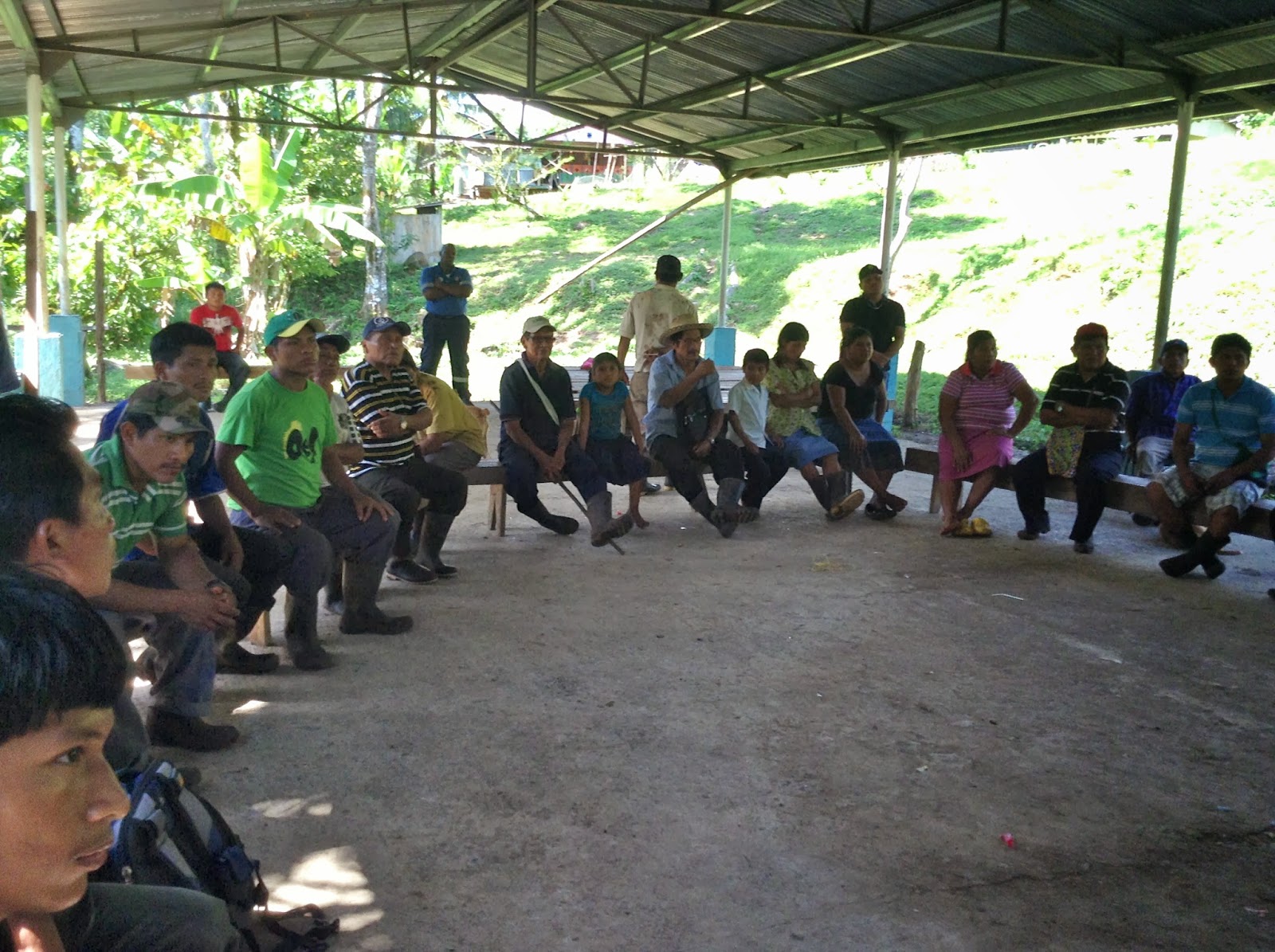
Since personal interaction is culturally expected in smaller Panamanian communities, I spent several weeks visiting every single family in my community with personal invitations to the meeting.  Thanks to this (and also potentially to food bribery) I had a great turnout of nearly 30 people!  That's almost 30% of my community, and a huge number considering that some people had to hike an hour to arrive in town.  


I was also really happy with how the project planning turned out.  They identified multiple community weaknesses they want to work on including the lack of group organization and financial planning, and poor plantation management.  

All of this considered, it looks like I have my hands full for the next few months.  Now here's hoping that their motivated attitudes will stick!